Underwriting & risk teams independent auto lending

The losses are already in the application. Your underwriters just can't see them yet.

Every deal carries a dealer story, a collateral story, a deal-structure story. Sidecar puts all of it next to the application — deal, dealer, vehicle, and reliability risk, each read against your own loan history — the moment the decision gets made.

Book a 15-minute demo
60-day money-back guarantee. Live in days, not quarters — no LOS integration.
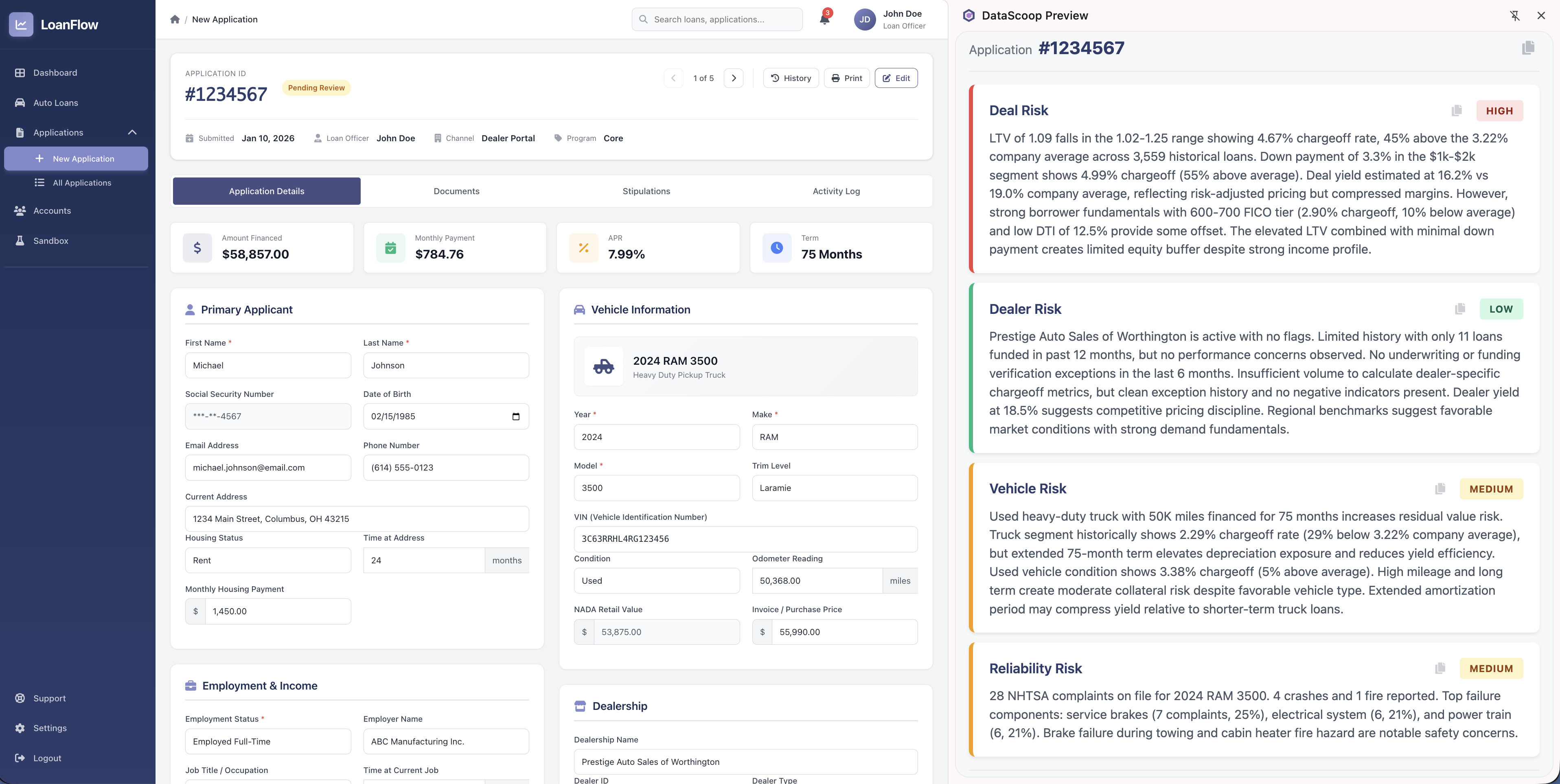
LOAN ORIGINATION SYSTEM — NEW APPLICATION
A live indirect auto loan application open in the loan origination system on the left, with the DataScoop side panel on the right. The panel shows Deal Risk (High), Dealer Risk (Low), Vehicle Risk (Medium), and Reliability Risk (Medium) — each written out and assessed against the lender's own historical loans.
A real read on a real deal. The application open in the LOS (left); Sidecar's read alongside it (right) — deal, dealer, vehicle, and reliability risk, each assessed against the lender's own historical loans, the moment the underwriter makes the call.
Our position

If it doesn't show up in your own numbers, we don't want your business.

We're not here to sell you a dashboard. We're here to move your loss curve. So we put the risk on us: put Sidecar to work for 60 days, and if your team uses it and it isn't earning its place against your own book, we give back every dollar.

The 60-day guarantee
  • The full product for 60 days. Your underwriters, real deals — not a stripped-down pilot.
  • Live in days. No LOS integration, no IT project, no vendor build.
  • Measured against your baseline. We agree how we'll judge it up front, before go-live.
  • Not earning its place? Full refund. The only condition is that the desk actually uses it.
The problem

The context that becomes your charge-offs never reaches the desk in time.

On the application, the deal looks like every other deal. The signals that actually predict the charge-off live somewhere else — in your own loss runs, in a dealer scorecard, in NHTSA's complaint data, in your most senior underwriter's head.

By the time those signals are assembled, the loan is already funded. So consistency drifts across the floor, new underwriters guess, and the risk only surfaces months later in the loss curve — where it's expensive and too late to undo.

?
Which dealers are sending paper that goes bad — and which have a clean record so far?
?
Does the vehicle itself carry mechanical or residual risk that erodes the collateral?
?
How does the structure — LTV, down payment, term, yield — perform in your own book?
?
And is this segment one your historical loans have already learned is expensive?
What Sidecar surfaces

Four reads on every deal — written out beside the loan.

Each read is assessed against your own historical loans and carries its own severity. The figures below are the actual reads from the deal shown above.

HIGH · DEAL01

Deal risk

LTV, down payment, structure, and yield read against your own historical loans — with the segment charge-off rate, your company average, and the loan count behind it, then weighed against the borrower's FICO tier and DTI.

From this dealLTV 1.09 → 4.67% charge-off · 45% above your 3.22% average across 3,559 loans · yield 16.2% vs 19.0%
LOW · DEALER02

Dealer risk

The dealership's flag status, funding volume, and underwriting and funding-verification exception history — with dealer-specific charge-off metrics where volume allows, dealer yield, and regional benchmarks.

From this dealPrestige Auto Sales · 11 loans funded / 12mo · no exceptions in 6mo · dealer yield 18.5%
MEDIUM · VEHICLE03

Vehicle risk

The collateral's segment charge-off history, condition, and mileage — and how the term affects depreciation exposure, residual value, and yield efficiency.

From this dealUsed HD truck · 50K mi · 75mo term → elevated depreciation & residual risk · condition 3.38% c/o
MEDIUM · RELIABILITY04

Reliability risk

Make-, model-, and year-level mechanical reliability from NHTSA — complaint volume, crashes and fires, and the top failure components by system, with the notable safety concerns called out.

From this deal2024 RAM 3500 · 28 NHTSA complaints · 4 crashes, 1 fire · brakes 25%, electrical 21%, powertrain 21%

Copy any read as an examiner-ready credit memo. One click captures the full reasoning behind the decision — the same write-up every time, ready for the loan file and the exam.

How it's delivered

Built for the desk, not the IT backlog.

Sidecar is a browser side panel that rides alongside any web-based LOS. Your underwriters never leave the application — and you're not waiting on an 18-month integration queue to find out if it works.

Day one

Live, nothing to connect

The side panel rides alongside the LOS your team already uses. No integration to build, nothing for your LOS vendor or IT to approve. Underwriters see the read on the very first deal.

First weeks

It becomes the habit

The panel earns its place in the workflow — a glance before every fund. We work with the desk so it's used, not ignored. That adoption is the whole point, and it's what we measure.

From there

It sharpens to your book

Connect your own servicing data and the reads move from industry-wide to portfolio-specific — your dealers, your segments, your loss history, read against the deal in front of the underwriter.

Cold-start data

You don't have to connect anything to get value on day one. Sidecar starts on a dataset we built from raw SEC ABS-EE loan-performance filings — industry-wide deal, vehicle, and segment signal your underwriters can use immediately. It's a starting point, not your book: as you run, your own servicing data takes over and the reads get sharper and more yours.

Why it compounds

Better context at the point of decision compounds across every loan.

Better decisions

Risk the application can't show

The dealer behind the deal, the collateral inside it, the structure around it — written out before you fund, not discovered after you've booked the loss.

Faster decisions

The read is already there

No toggling between the LOS, spreadsheets, and dashboards to assemble the picture. It's in the panel, beside the deal, while you're still on the application.

Consistent reasoning

The floor decides like your best

The same written read on every deal — ready to copy as an examiner-ready credit memo, identical whether it's your most experienced underwriter or your newest hire.

Stronger decisions on every deal compound into a stronger book — one built to grow the channel, not just survive it.

Static scorecards vs. Sidecar

Your scorecard is a rear-view mirror. Sidecar watches the road.

The scorecard

Scores the borrower's past

Refreshed once or twice a year, it scores the individual applicant's credit history — and stops there.

  • Built around the borrower alone
  • Blind to the dealer, vehicle, and structure
  • One number, no reasoning to read
  • Surfaces a trend long after it's cost you
Sidecar

Reads the risk around the deal

Read against your own historical loans, it lays out the environment around the application — the deal structure, the dealer, the vehicle, the segment — at the second of decision.

  • + Weighed against your own loan history
  • + Reads the whole context, not just the credit
  • + Calls out deal, dealer, vehicle & reliability risk
  • + The underwriter decides — better informed
Proof

In production with a high-volume lender for over a year.

1+ yr

In daily production with a large independent auto lender — less manual effort for experienced underwriters, less guesswork for new ones.

HIGH-VOLUME DESK REAL DEALS EVERY DAY
"
DataScoop has substantially reduced the time and cost of manually evaluating an application, and let us look up dealership performance in real time — without leaving the loan in the LOS.
Head of Underwriting Large independent auto lender
Common questions

The questions every risk team asks.

Where does the data come from?
Two sources, in sequence. On day one, Sidecar runs on a dataset we built from raw SEC ABS-EE loan-performance filings — industry-wide deal, vehicle, and segment signal, so your underwriters get value before anything is connected. As you run, you connect your own servicing data, and the reads move from industry-wide to your-portfolio-specific. The starter data gets you live fast; your data makes the reads yours.
We already have analytics in our LOS.
Your LOS is built to originate and process the loan. Sidecar adds the risk context around it — segment charge-off rates across thousands of your own loans, dealer exception history, yield-to-loss by structure, and make-model reliability signals from NHTSA. It's the layer between reading the deal and understanding the risk, and it rides right alongside the system you already use.
How does it work with our LOS?
It runs as a side panel in the browser, alongside whatever web-based LOS your team already uses. There's no integration to build and nothing for your LOS vendor or IT team to approve a project for. That's why a lender can be live in days, not quarters.
What if it doesn't reduce our losses?
Then we don't want your business — and we mean that. It's backed by a 60-day money-back guarantee. We agree up front how we'll measure it against your own baseline. If your desk uses it and it isn't earning its place, we refund you in full. The one condition is adoption: Sidecar only works if the underwriters actually look at it, so that's what we measure and help you get to.
Does Sidecar make the decision?
No. Sidecar surfaces the risk read; your underwriters decide. It doesn't auto-approve, auto-decline, or replace judgment — it writes the deal, dealer, vehicle, and reliability picture out beside the loan, so the call is better informed. The decision — and the examiner-ready credit memo behind it — stays yours.
See the risk before you fund

Book 15 minutes on a deal like yours.

We'll walk you through exactly what Sidecar surfaces on the kind of deal your desk sees every day — deal, dealer, vehicle, and reliability risk, each read against your own loan history, all in one panel — backed by a 60-day money-back guarantee.

60-day money-back guarantee. Live in days, not quarters · works with any web-based LOS · your data, your loss history.